
From Feedback to Strategy: Using Survey Data to Strengthen Pricing Decisions

Are your member surveys capturing the right data or are you missing opportunities to guide pricing strategy?
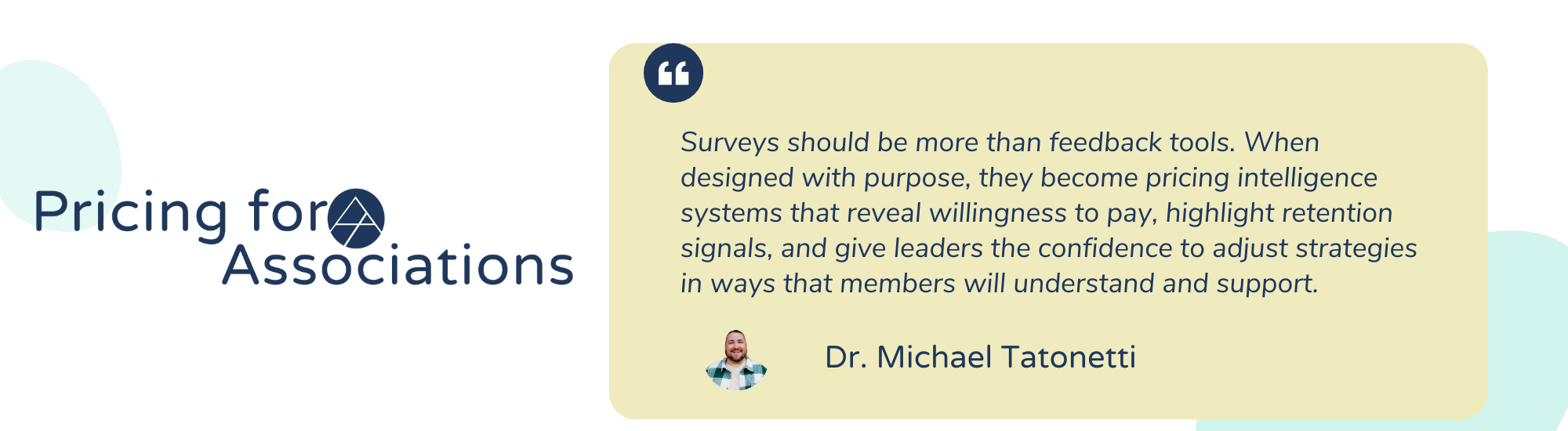
Too often, associations run surveys filled with outdated questions, collecting information that sits unused. But when designed with precision, surveys can do more than measure satisfaction, they can shape pricing, improve retention, and strengthen trust with members.
Here’s how associations can rethink survey design to turn raw data into strategic pricing intelligence.
1. What Strong Survey Design Looks Like
Effective surveys should do more than generate reports. The best-designed surveys:
Ask dual-purpose questions to maximize efficiency and value.
Remove stagnant or irrelevant items to streamline and sharpen focus.
Align with strategic priorities, ensuring every question has organizational purpose.
Include value-back questions, helping members see their input reflected in outcomes.
Track longitudinally, capturing trends over time for program and pricing evaluation.
Standardize data with dictionaries and libraries for consistency across years.
This approach ensures every question contributes to actionable insights.
2. Why Survey Data Matters for Pricing
When connected to pricing, survey data becomes even more powerful:
Willingness-to-pay insights – Pricing questions reveal tolerance levels and member priorities.
Retention signals – Value-back questions help reduce price sensitivity.
Trend analysis – Longitudinal data highlights when and where to adjust pricing.
Strategic alignment – Pricing decisions reflect what members identify as most valuable.
Storytelling with data – Survey results give boards and members confidence in pricing changes.
Surveys stop being an isolated research exercise and start fueling financial strategy.
3. How Associations Can Apply This Approach
To put survey data to work in pricing strategy:
Embed pricing intelligence into surveys (value ranking, willingness-to-pay).
Streamline to essential questions that influence pricing or strategy.
Track over time to identify when value perceptions shift.
Close the loop by showing members how their feedback shaped pricing.
Build a pricing data library to support future pricing conversations with leadership and members.
Conclusion
Surveys aren’t just about listening, they’re about acting. By designing smarter questions and linking data directly to pricing, associations can demonstrate responsiveness, strengthen loyalty, and make pricing decisions with greater confidence.
Are you ready to tackle your association’s pricing problems? Visit www.pricingforassociations.com today to schedule a virtual coffee chat where we can discuss what your organization needs and how we can best support you.